
How it works
An AI companion you can see into.
You deserve to know exactly what happens when you talk to Yuyu: how it listens, where its methods come from, what it does in a hard moment, and where your words go. Here it is, plainly.
The short version
-
Yuyu is an AI.
It's software built on large language models, shaped by Serenio to listen carefully. Its replies are written by the AI: no one reads along or types on the other side.
-
A companion, not a clinician.
Yuyu doesn't diagnose, prescribe or treat. It's here for everyday feelings, and it points you toward professionals and helplines when that's what you need.
-
Safety runs first.
Every message is checked for signs of crisis before Yuyu writes a word, and support lines are always one tap away.
-
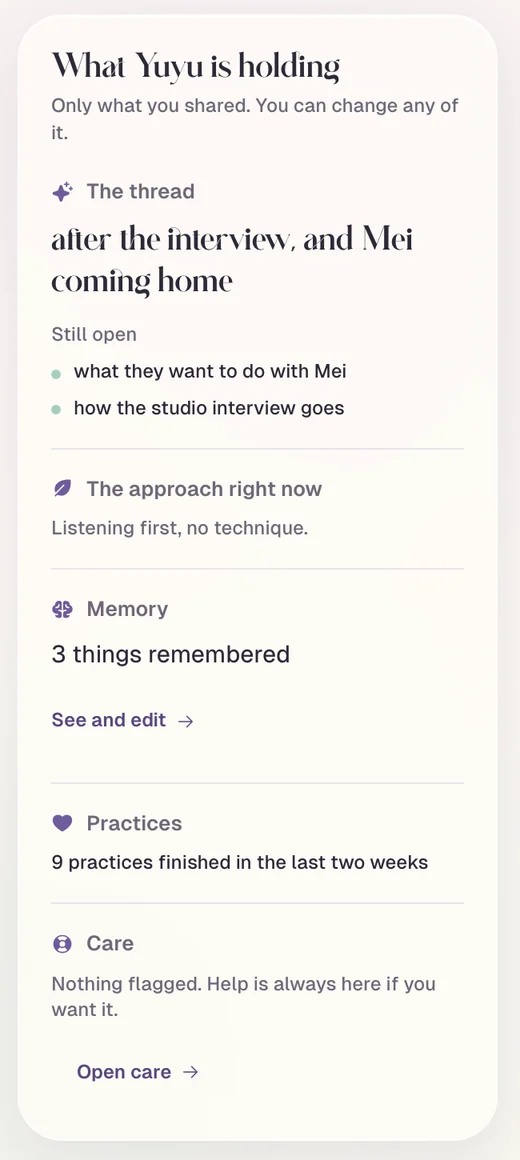
What it keeps, you can see.
Read, edit or forget what Yuyu remembers. Download everything, or delete your account, whenever you like.
Every message
What happens when you send a message
Six steps, in order. The first two exist only to keep you safe.
-
Safety
A safety check, before anything else
The moment your message arrives, it is screened for crisis language in English, Traditional and Simplified Chinese, written Cantonese, Japanese and Korean. It takes under a millisecond and runs before anything else, even before we check who you are. It understands everyday idioms, so 熱到想死 (“so hot I could die”) isn't mistaken for a crisis.
-
Safety
A second, closer read
A separate AI model reads your last three messages for less obvious signs of risk. It is instructed to judge meaning rather than keywords, and to choose the more careful answer when it's unsure. With clear signs of crisis, Yuyu replies with words written in advance by people, not generated on the spot, and shows support lines you can call with a tap. With less clear signs, Yuyu slows down and asks you directly about your safety.
-
Only the context you've shared
To reply, Yuyu draws on what you've given it: the name you'd like to be called, your age range, the note you wrote about yourself, short summaries of recent conversations, the memories most relevant right now, the practices you've tried lately and, in a hard moment, parts of your own safety plan. It doesn't look you up anywhere else.
-
Reflect first, then think it through
Yuyu's first job is to say back what it heard, as accurately as it can, before offering any advice. Then it gently helps you look at things from more than one side.
-
One small practice, only when it fits
If a practice might help, Yuyu offers one: never in your first couple of messages (except breathing or grounding), and no more than once every six replies. It won't lecture, name techniques or hand you a worksheet, and “not now” is always an answer.
-
Afterwards, a quiet note
Yuyu notes the feeling underneath (calm, reflective, hopeful, tender, heavy, activated or guarded), updates its summary and keeps any new memories, which you can see and edit. It's a reflection, never a diagnosis. Moments of crisis are never turned into memories.
The methods
Decades of psychology, adapted for a conversation.
Most of Yuyu's practices are adapted from cognitive behavioural therapy (CBT), one of the most extensively researched approaches in psychology. We turn them into small, conversational steps. Using a technique that comes from therapy doesn't make Serenio therapy, and we don't claim it does.
| In Serenio | Where it comes from | What it's for |
|---|---|---|
| Reflecting back | Where it comes fromReflective listening, from client-centred counselling[1] | What it's forFeeling understood before anything else |
| Untangle a thought · A thinking trap? | Where it comes fromThought records and thinking traps (cognitive distortions), from CBT[2][3] | What it's forSlowing a thought down to find a fairer one |
| What if the worst happens? | Where it comes fromDecatastrophising, from CBT[2] | What it's forSeeing a worry at its real size |
| Reframe with Yuyu | Where it comes fromSocratic questioning, from CBT[2] | What it's forTalking a thought through, one question at a time |
| One small step | Where it comes fromBehavioural activation[4] | What it's forSomething doable, and when |
| Think a problem through | Where it comes fromProblem-solving therapy[5] | What it's forOptions, a choice and a first step |
| Worry time | Where it comes fromWorry postponement[6] | What it's forParking a looping worry until later |
| Ground me | Where it comes from5-4-3-2-1 sensory grounding | What it's forComing back to the present, one sense at a time |
| Breathe with me · Breathing space | Where it comes fromPaced breathing (box and 4-7-8) | What it's forSlowing down with a steady count |
| A kinder voice | Where it comes fromSelf-compassion[7] | What it's forSpeaking to yourself as you would to a friend |
| What matters to me | Where it comes fromValues clarification | What it's forNaming what matters, and one small way to live it |
| My safety plan | Where it comes fromThe Safety Planning Intervention[8] | What it's forA plan written in calm, for the hard moments |
| A gentle check-in | Where it comes fromThe PHQ-9 and GAD-7 questionnaires[9][10] | What it's forNoticing how heavy the last two weeks have been |
The check-in uses the published PHQ-9 and GAD-7 questions word for word, in all four languages, with their standard scoring. Results are a snapshot of the last two weeks, not a diagnosis; only a qualified professional can diagnose. If you answer that you've had thoughts of hurting yourself, Yuyu offers support straight away.
Hard moments
When a conversation gets heavy.
Serenio is built for everyday feelings, but hard moments happen. This is exactly what Yuyu does.
-
Words written by people, straight away
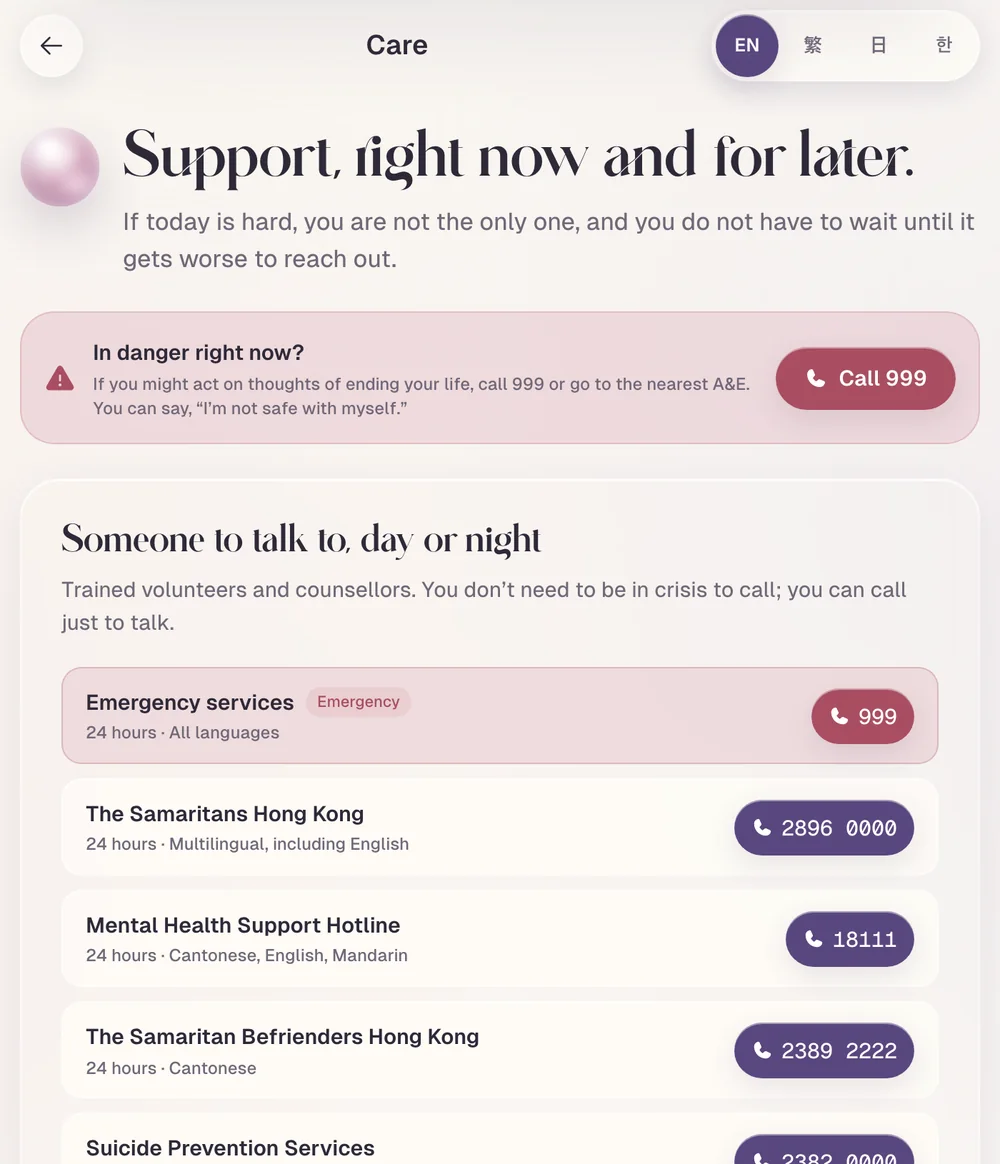
When there are clear signs of crisis, Yuyu doesn't improvise. It replies with a message written in advance by people, and shows 24-hour support lines you can call with a tap. In Hong Kong: emergency services (999), The Samaritans (2896 0000), the Mental Health Support Hotline (18111), The Samaritan Befrienders (2389 2222) and Suicide Prevention Services (2382 0000). When you write in Japanese or Korean, you'll see lines in Japan or Korea too.
-
Then Yuyu stays
For the next hour, Yuyu answers under crisis guidance: it slows down, asks directly about your safety and doesn't end the conversation. It won't diagnose, name disorders, give advice about medication or promise outcomes.
-
Your own plan, when you need it
In calmer moments you can write a safety plan in seven steps: warning signs, things that help, people and places, who to ask, professionals to contact, making your space safer, and what you're living for. When things get heavy, Yuyu can bring it back to you.
-
Help is one tap from every screen
A support button sits on every tab, and Serenio's support page works for anyone, with no account needed.
Serenio is not an emergency service.
We don't monitor conversations, and no one is alerted if you're struggling. If you might act on thoughts of ending your life, call 999 in Hong Kong or your local emergency number, or go to the nearest emergency department.
Your data
Where your words go.
Plain answers, with nothing tucked away. The full details are in our Privacy Policy.
-
Where it's stored
Your account and history are stored with Supabase, on Amazon Web Services in Mumbai, India. Each account can only read its own records, photos and voice notes sit in private storage behind links that expire, and data is encrypted in transit and at rest.
-
Who helps Yuyu reply
Your message and its context go to Microsoft Azure OpenAI Service to write the reply, with OpenAI as a backup and for background work such as safety checks, memory and transcription. Neither uses your data to train its models. Your email address is never sent.
-
What you control
See, edit, pause or forget what Yuyu remembers. Delete a journal page and what Yuyu learned from it goes too. Download everything, or delete your account and all of it, from inside the app. For data from older versions of the app, email us.
| Service | What it does for Serenio | Where |
|---|---|---|
| Supabase (on Amazon Web Services) | Stores your account, history, photos and voice notes | Mumbai, India |
| Vercel | Runs the web app and its servers | Mumbai, India |
| Microsoft Azure OpenAI Service | Writes Yuyu's replies, and transcribes voice input in the iPhone app | Microsoft Azure data centres |
| OpenAI | Backup replies; safety checks, memory, reflections, photo checks and voice transcription | United States |
| Volcengine (ByteDance) | Paints a journal video, only if you ask for one. It receives a short description that includes up to 600 characters of your latest conversation. | Mainland China |
| Apple | Speech recognition in iPhone voice conversations | On your iPhone, or Apple's servers |
- No ads
- No selling your data
- No analytics trackers in the apps
This website (serenio.ai) uses Google Analytics to count visits, and skips it entirely if your browser asks not to be tracked.
Testing
How we check our work
- Our automated test suite, hundreds of tests across the web and iPhone apps, includes a multilingual set of crisis and everyday messages for the safety checks. It's an internal check, not a clinical validation, and no automated check catches everything.
- Idioms and slang are part of that set, so everyday phrases don't set off false alarms, and a clear sign of crisis is never talked down by the second check.
- The web app's screens are scanned with automated accessibility tests against WCAG 2.2 AA.
- Safety events are logged as category codes only, never with your words.
Limits
What Serenio can't do
- Serenio hasn't been tested in clinical trials, and it isn't a medical device. It's a companion for everyday wellbeing.
- AI can misunderstand or get things wrong. You know your life best, so take what helps and leave the rest.
- No one watches conversations as they happen, and Serenio can't send help to you.
- Yuyu can't replace the people in your life or professional care, and it's designed to point you toward both.
- Serenio is for adults aged 18 and over.
References
The original work behind Serenio's practices. Citing it doesn't mean the authors have reviewed or endorsed Serenio.
- Rogers, C. R. (1951). Client-Centered Therapy: Its Current Practice, Implications, and Theory. Houghton Mifflin.
- Beck, A. T., Rush, A. J., Shaw, B. F., & Emery, G. (1979). Cognitive Therapy of Depression. Guilford Press.
- Burns, D. D. (1980). Feeling Good: The New Mood Therapy. William Morrow.
- Jacobson, N. S., Dobson, K. S., Truax, P. A., et al. (1996). A component analysis of cognitive-behavioral treatment for depression. Journal of Consulting and Clinical Psychology, 64(2), 295–304.
- D'Zurilla, T. J., & Goldfried, M. R. (1971). Problem solving and behavior modification. Journal of Abnormal Psychology, 78(1), 107–126.
- Borkovec, T. D., Wilkinson, L., Folensbee, R., & Lerman, C. (1983). Stimulus control applications to the treatment of worry. Behaviour Research and Therapy, 21(3), 247–251.
- Neff, K. D. (2003). Self-compassion: An alternative conceptualization of a healthy attitude toward oneself. Self and Identity, 2(2), 85–101.
- Stanley, B., & Brown, G. K. (2012). Safety Planning Intervention: A brief intervention to mitigate suicide risk. Cognitive and Behavioral Practice, 19(2), 256–264.
- Kroenke, K., Spitzer, R. L., & Williams, J. B. W. (2001). The PHQ-9: Validity of a brief depression severity measure. Journal of General Internal Medicine, 16(9), 606–613.
- Spitzer, R. L., Kroenke, K., Williams, J. B. W., & Löwe, B. (2006). A brief measure for assessing generalized anxiety disorder: The GAD-7. Archives of Internal Medicine, 166(10), 1092–1097.
See for yourself
Try Serenio. It's free.
On iPhone or on the web. Talk to Yuyu for a minute, and see how it feels to be heard first.